
info@nicosafety.com
+91 9987907788
Protective clothing is designed to safeguard workers against a wide range of workplace hazards, but not all PPE provides the same level of protection. International PPE standards define the performance, testing, and certification requirements that protective clothing must meet to ensure it is suitable for specific applications.
Understanding these standards helps employers and workers select PPE that offers the appropriate level of protection while meeting recognised safety regulations.
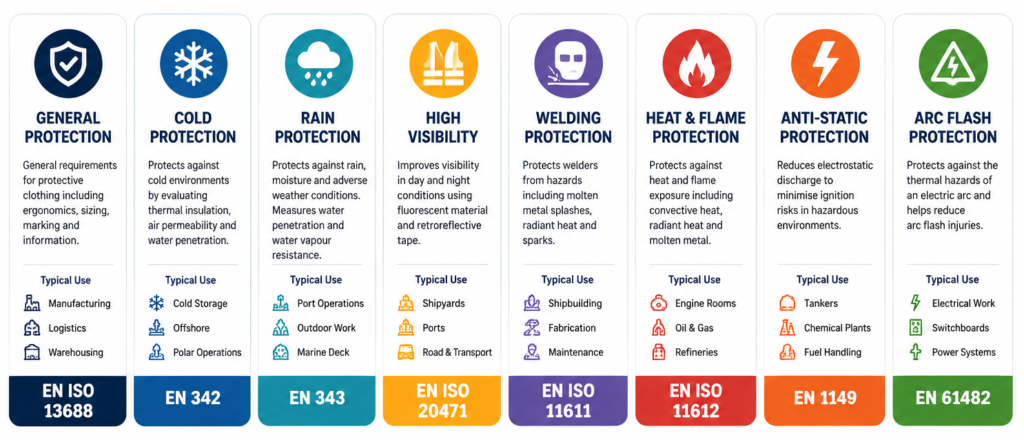
Personal Protective Equipment (PPE) standards are internationally recognized specifications that define the minimum performance, testing, and safety requirements for protective clothing and equipment. They ensure that PPE has been independently tested and certified to protect against specific risks such as heat, flame, rain, cold, welding, high visibility, electrostatic discharge, arc flash and mechanical risks.
Compliance with these standards gives employers and workers confidence that the PPE they are using has been evaluated under controlled laboratory conditions and meets strict quality and performance criteria. Rather than relying on appearance alone, certified PPE provides measurable protection that helps reduce workplace injuries and supports compliance with occupational safety regulations.
PPE must meet strict international standards to ensure it delivers the protection workers need in hazardous environments. Before PPE can be certified to a specific standard, it undergoes extensive laboratory testing by accredited organizations. Depending on the intended application, products are tested for properties such as:
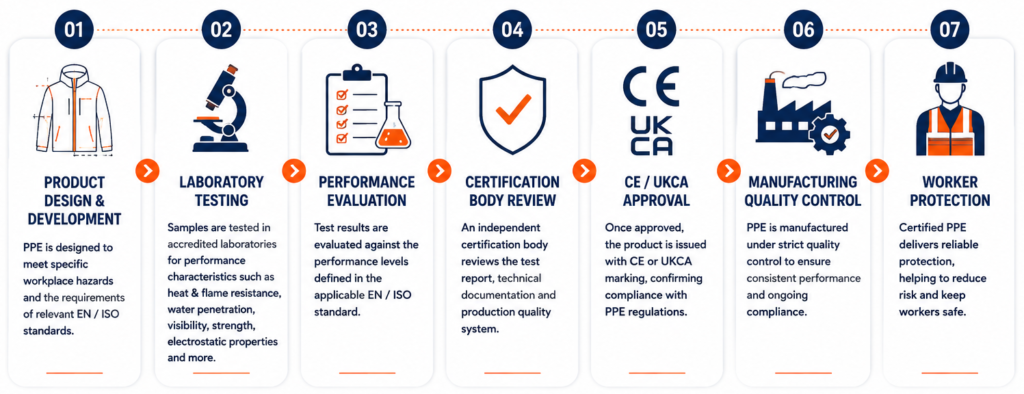
Certified PPE is typically supplied with a CE or UKCA marking, confirming that it complies with the relevant European or UK safety legislation. They are mandatory conformity indicators that show a product complies with essential health, safety, and environmental protection legislation. While they serve a similar purpose, they apply to different geographic jurisdictions and regulatory frameworks.
CE Marking – Indicates compliance with PPE regulations for the European Union (EU) and the European Economic Area (EEA). It is also accepted in certain other markets like Northern Ireland and Turkey. CE marking indicates that the product meets EU safety, health, and environmental standards and allows free movement of goods across the single European market.
UKCA Marking – Indicates compliance with PPE regulations for Great Britain. It was introduced following Brexit, and does not provide access to the EU market.
These markings provide assurance that the product has undergone independent conformity assessment and meets recognised safety requirements. When third-party testing is legally required, it must be performed by an EU/UK recognized body.
Selecting PPE should always begin with a workplace risk assessment. The correct standard depends on the hazards workers are exposed to, and in many cases, garments may need to comply with multiple standards simultaneously. When choosing PPE, always verify that the product:
Choosing certified PPE is not only essential for regulatory compliance but also plays a vital role in protecting workers, improving productivity, and reducing the risk of workplace injuries.
Looking for a trusted safety partner?
Contact NICO Marine today to discuss your requirements and let our experienced team support your operations with industry leading products, technical expertise, and responsive service.